Power Tools
Best Cordless Heat Guns Compared: DeWalt, HiKOKI, Makita and Milwaukee Tested
Four 18V cordless heat guns go head to head in melting, heat output and runtime tests to find which one deserves a spot on your bench.
Introduction
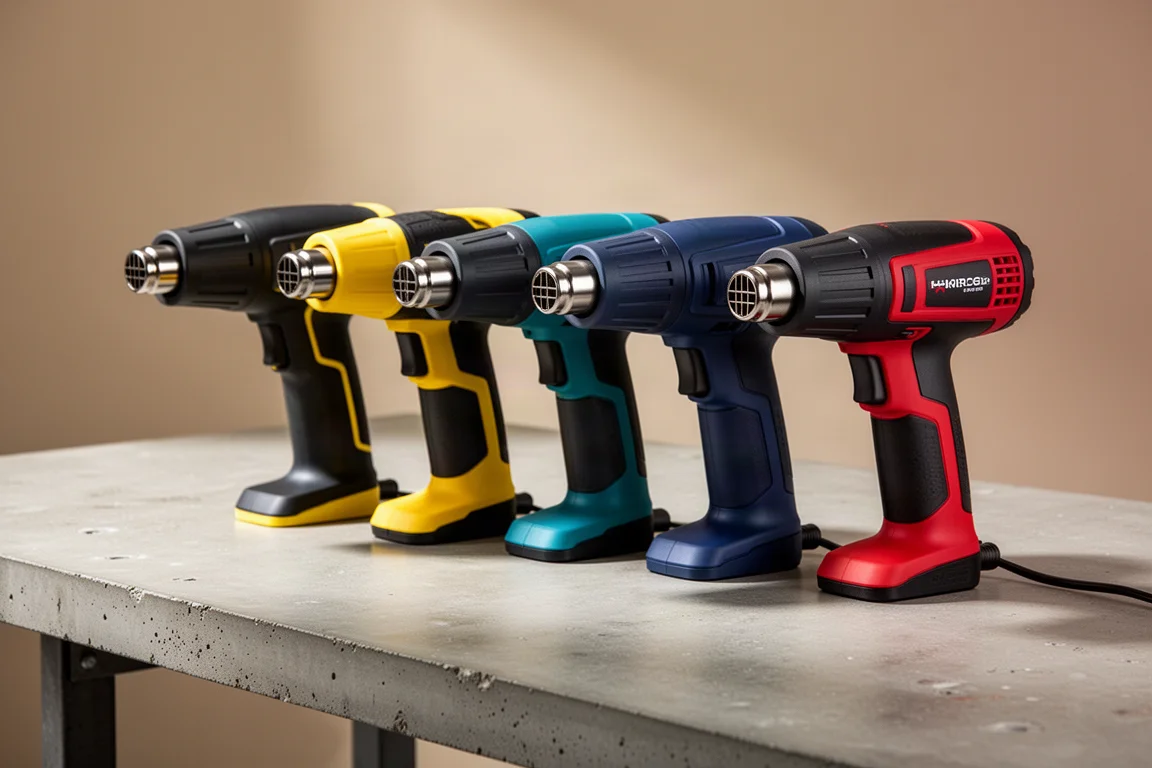
Cordless heat guns are not tools most people use every day, but when you need one, you really need one. The problem is that specs on the box rarely tell you how these tools actually behave side by side. To sort that out, four 18V cordless heat guns went through a practical comparison: the DeWalt DCE530, the HiKOKI RH18DA, the Makita DHG181 and the Milwaukee BHG. None of these tools were supplied by their manufacturers, so the results reflect ordinary bench testing rather than anything promotional.
The tests covered what each tool includes in the box, rated temperature and airflow, how well each one melts wax from a fixed distance, how quickly each heats a chunk of steel measured with a thermal camera, and how long each runs on the same 5Ah battery on the highest setting. Before buying any of them, it is worth knowing how differently they behave.
What’s in the Box
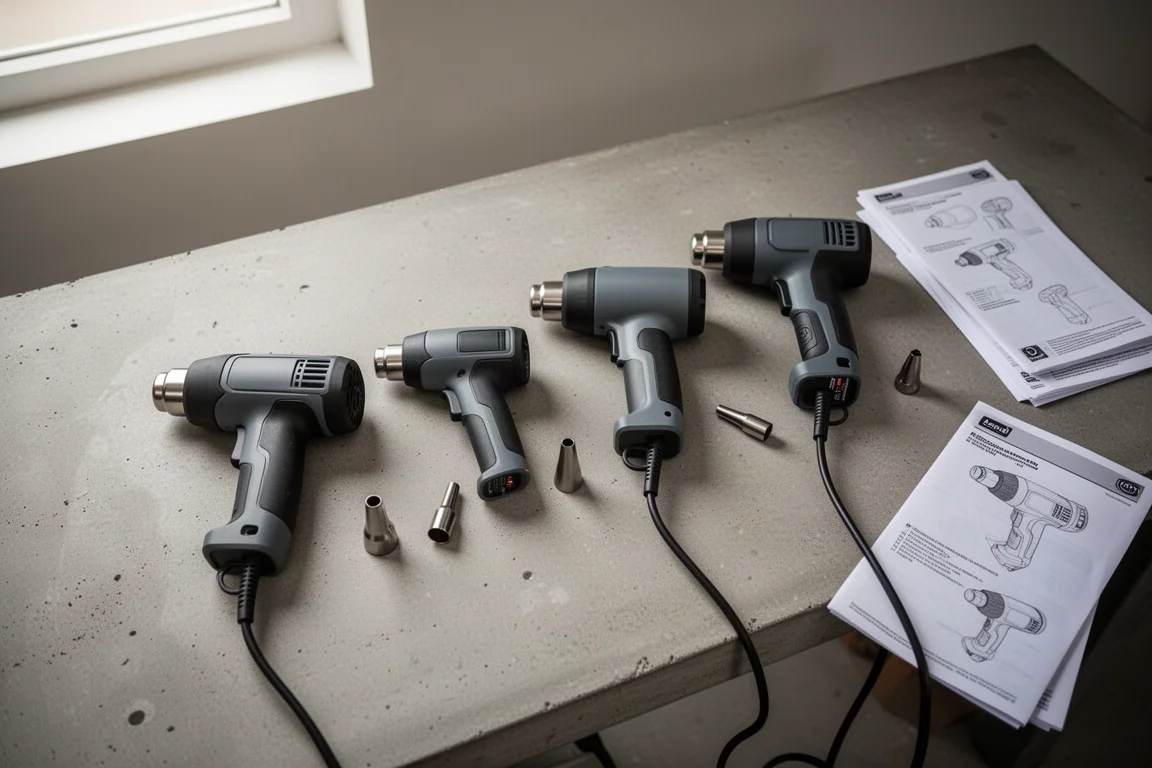
The DeWalt DCE530 ships as a bare tool with three attachments and a very light manual. The HiKOKI RH18DA is slightly larger and comes with three similar attachments, plus a digital control panel on the top. The Milwaukee BHG includes only two attachments and a manual so thin it barely justifies its place in the box. The Makita DHG181 is the most generous: it comes in a case, with four attachments, one more than the DeWalt and HiKOKI and twice as many as the Milwaukee. All four are made in China.
Specs and Design Differences
On paper, the manufacturers rate the HiKOKI and Makita at 550 degrees Celsius, the DeWalt at 530 degrees Celsius, and the Milwaukee at an odd Celsius figure that clearly came from converting a Fahrenheit rating of 875 degrees. Airflow separates them even more sharply. At maximum, the Milwaukee pushes 160 liters per minute, the DeWalt 190, the Makita 200 and the HiKOKI 300, almost double the Milwaukee. Combining airflow and rated temperature, the HiKOKI looks like the runaway favorite on paper.
The physical details also differ in ways that matter day to day. The DeWalt lacks the rear hook the other three have, and it is the lightest of the four by a considerable margin, roughly two-thirds the weight of the heaviest, the Milwaukee. Three of the four have a light at the bottom of the body, while the Milwaukee’s sits in line with the nozzle. The DeWalt, Makita and Milwaukee use a trigger and can be locked on; the HiKOKI uses a slide switch instead, and the Milwaukee cannot be locked on at all. The Milwaukee also only offers a single setting, while the other three have low and high modes. The Makita adds a temperature dial on the back, and the HiKOKI has a digital readout. The two Japanese brands both include a mechanism to help remove hot attachments, something the DeWalt and Milwaukee lack. One more quirk: the HiKOKI stands up poorly without a battery fitted and constantly wants to tip forward, while the other three balance well.
Candle Melting Test at Distance
The first hands-on test measured how much wax each gun could melt. The original plan was 200mm from the candle, but that proved too far to produce satisfying dripping and drooping, so the distance was cut to 100mm, with each gun running for one minute on its highest setting with no nozzle fitted.
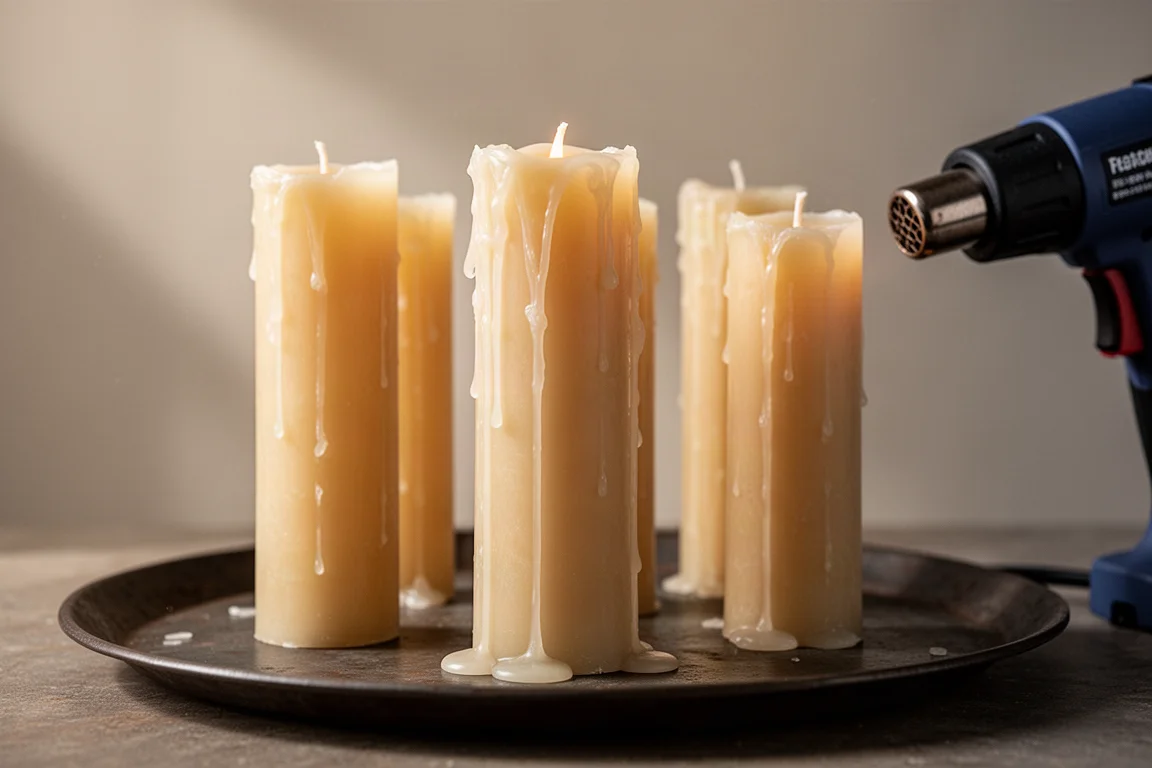
The Makita produced a noticeable dip and a small amount of drippage. The HiKOKI started strongly but ended up remarkably similar to the Makita, with a divot and some drippage despite its much higher rated airflow. The DeWalt showed a drip pattern more in line with the Makita but removed slightly less wax. The Milwaukee was the clear loser, removing well under half the wax of the other three, and it was also the most annoying to run because its trigger had to be held down the entire time. Visually, the DeWalt, HiKOKI and Makita ended up quite close in wax volume removed.
Heat Test on Steel
To get a more objective temperature reading, each gun was run for the same length of time at the same distance against a chunky piece of steel, with a thermal imaging camera capturing the temperature at the one-minute mark. Stainless brackets proved too shiny and erratic for reliable readings, hence the switch to the steel block.
The results lined up with the rated temperatures. The Makita heated the steel fastest, followed by the HiKOKI, then the DeWalt, with the Milwaukee trailing. At the one-minute mark the DeWalt had taken the steel from around 16 degrees up to 33.3 degrees. A follow-up airflow check with a meter confirmed the HiKOKI’s rated advantage was real, measuring a solid 1.3 meters per second against the Makita’s roughly 1.0, so the earlier hunch that the Makita felt stronger was wrong.
Battery Runtime Test
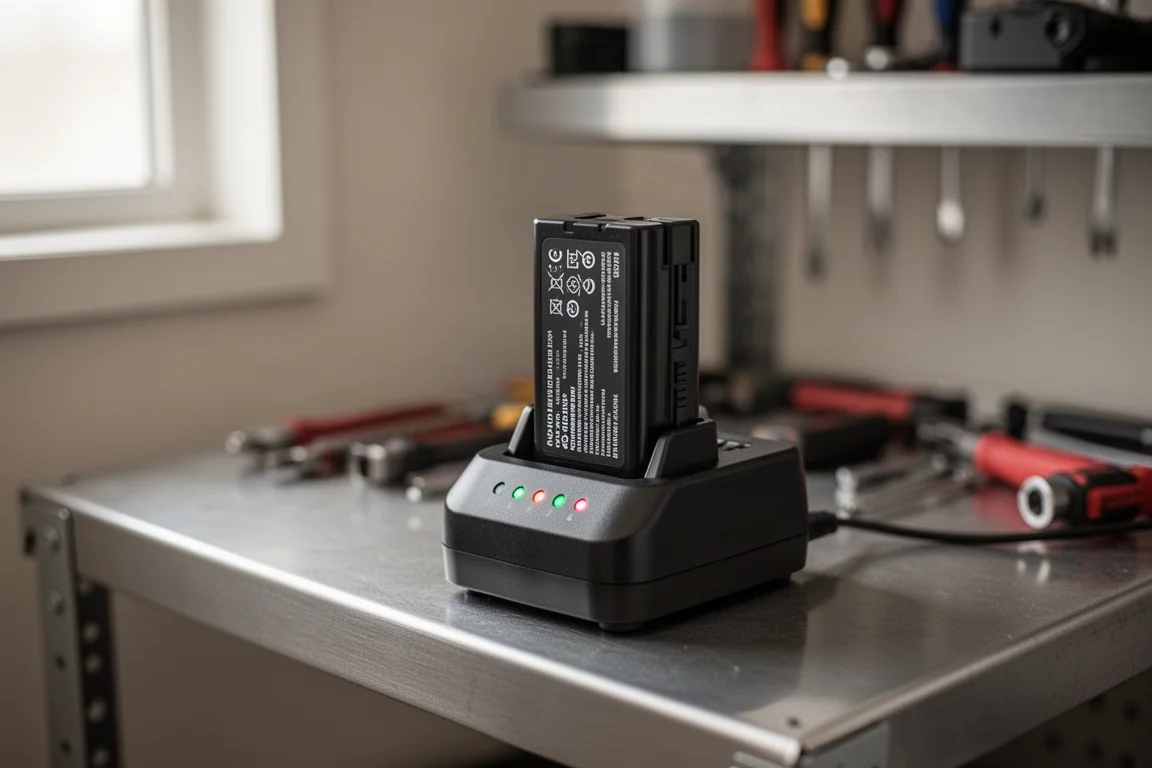
Runtime was tested with a 5Ah 18V battery on each tool, all set to their highest setting, with the timer started on each gun in turn. The Milwaukee lasted the longest, finishing at around 18 minutes 23 seconds, roughly four minutes longer than the HiKOKI. That is a substantial gap, though by the end the Milwaukee was winding down noticeably and probably not throwing out much heat, whereas the HiKOKI ran more evenly before stopping earlier.
Heat behavior after the test also differed. The HiKOKI’s battery and tool were essentially cold. The Makita and DeWalt batteries were fractionally warm, and the DeWalt refused to charge immediately afterwards because it was too hot, and unlike the HiKOKI and Makita chargers it has no cooling fan, so it took a while before it would accept a charge. The Milwaukee ran longest but finished much hotter, with a handle that felt hot and sticky, which is unusual.
Noise Levels
Sound is easy to overlook until you use the tool for more than a few minutes. The DeWalt is the worst offender here, producing a high-pitched whine that would be genuinely unpleasant for regular use. The Makita sounds like a weak hairdryer, and the Milwaukee is not as bad as the DeWalt but still somewhat whiny.
Final Ranking and Verdict
If only one of these could be owned, the HiKOKI RH18DA is the pick. It has the best combination of features: the rear hook, the best switch of the bunch because it goes straight on with no fiddling, the hot-attachment ejection mechanism, the light, and the digital readout that lets you dial in a temperature from 30 degrees upward in 10-degree increments on the low setting, up to a maximum of 400 degrees, with 550 available on the high setting. You do have to have the tool running to change the temperature, unlike the Makita’s dial which can be preset between one and six before switching on, though there is no way to know exactly what those dial numbers mean in degrees.
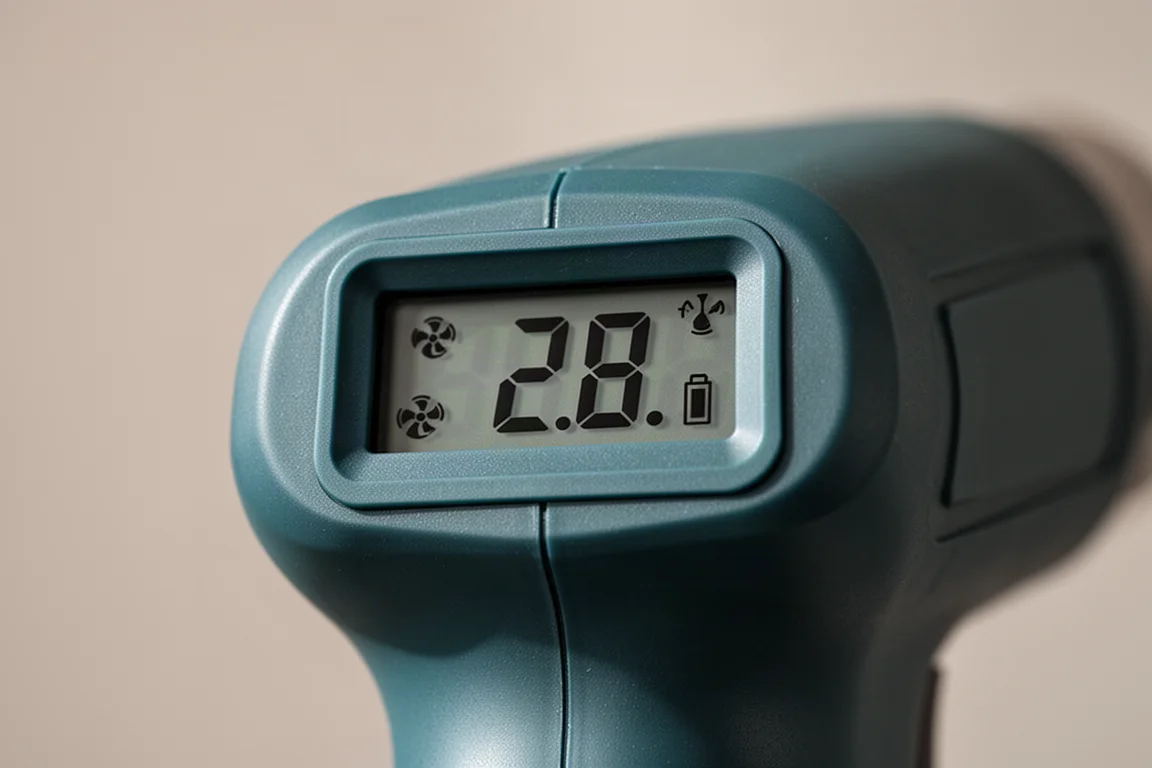
The overall ranking comes out as HiKOKI first, Makita second, DeWalt third and Milwaukee last. The DeWalt is worth considering if you want a light tool that performs well, but the noise alone is a real drawback. The Milwaukee’s inability to lock on unless you improvise with a zip tie or velcro strap, its single setting and its weak wax-melting result put it firmly at the back of the pack, despite winning the runtime test.
One honest caveat applies to all four: none of them come close to the power of a corded heat gun, so anyone expecting to strip paint or do heavy shrinking work quickly should temper expectations. These are convenient tools for light jobs, not corded replacements.
Conclusion
For most buyers the HiKOKI RH18DA is the strongest all-rounder here, pairing the highest airflow and temperature rating with the best control scheme and most complete feature set. The Makita DHG181 is the close runner-up and the best packaged, with the most attachments and a case included. The DeWalt DCE530 is the lightweight option that performs decently but sounds unpleasant. The Milwaukee BHG offers the longest runtime but the weakest heat delivery and the least flexible controls. Match your choice to how often you will actually reach for it, and the HiKOKI’s combination of features makes it the easiest to recommend.
Product link
View more details for DeWalt DCE530
This product is mentioned in the review. Check the specifications, options, and compatibility before buying.
View more details for DeWalt DCE530Further reading
Related Reviews

Power Tools
Best 1-Inch Pistol Impact Wrenches: Three Heavy-Duty Options Compared
We compare three 1-inch pistol impact wrenches, from a budget-friendly Harbor Freight model to a premium Caterpillar unit, to help you choose the right one.

Power Tools
Best 3/4-Inch Impact Wrenches 2026: Five Contenders Compared
We compare five 3/4-inch impact wrenches across price and performance, from a budget Amazon option to Snap-on's most powerful model yet.

Power Tools
Best Budget Cordless Tools 2026: Walmart Finds That Punch Above Their Price
We tested five cordless tools from Walmart, including a high-torque impact wrench that trades blows with Milwaukee and a $35 duster that outperforms its price class.